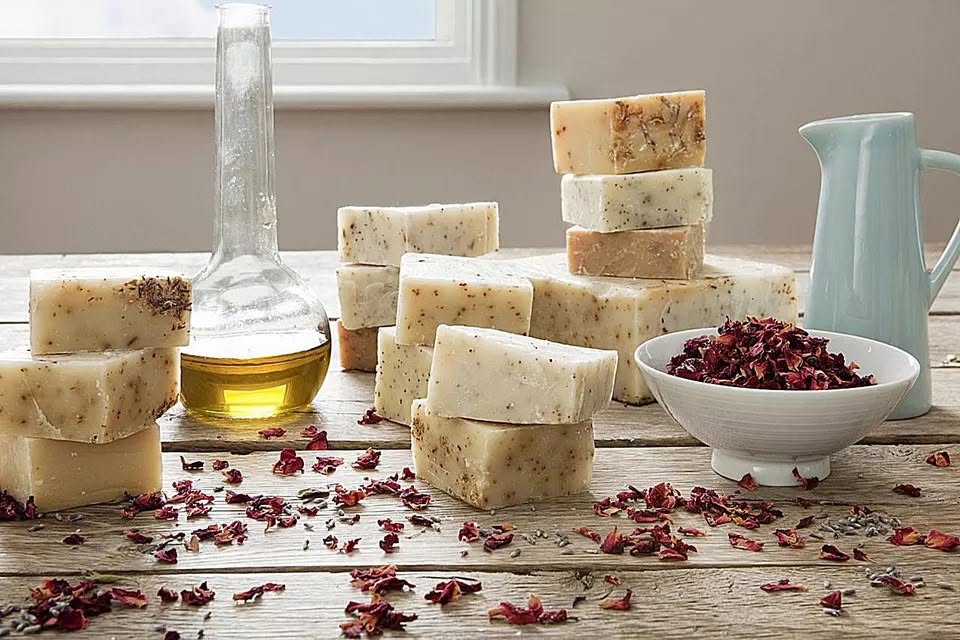
Every Rose soap begins with ingredients—but turning those ingredients into a beautifully finished bar requires several carefully controlled stages.
Soap making is both a craft and a science. From selecting and measuring the oils to mixing, molding, cutting and curing, each stage contributes to the character and quality of the finished soap.
Step 1: Selecting the Ingredients
The process begins by choosing the oils, butters and other ingredients required for a particular formulation.
Each oil behaves differently in soap, which means the combination and proportions need to be carefully considered. Our guide to natural oils in soap explains the role of these ingredients.
Depending on the product, additional ingredients may include botanical extracts, clays, herbs, natural-inspired fragrances or other ingredients selected for the particular soap.
Step 2: Precise Measurement
Consistency starts with accuracy.
Ingredients are carefully weighed according to the formulation. Correct measurements are particularly important in soap making because the oils and alkaline solution must be properly balanced for the saponification process.
Step 3: Saponification
This is where oils become soap.
When the prepared oils are combined with an alkaline solution under appropriate conditions, a chemical reaction called saponification begins.
The original ingredients gradually transform into soap, while glycerin is naturally produced as part of the reaction.
Step 4: Creating the Character of the Soap
Once the soap mixture reaches the appropriate stage, ingredients that give each Rose soap its individual character can be incorporated according to its formulation.
This may include fragrance, botanical ingredients, clays or other carefully selected additions.
The mixture is then poured into molds and allowed to set.
Step 5: Cutting the Bars
After the soap has hardened sufficiently, it is removed from its mold and carefully cut into individual bars.
At this stage, the soap already looks familiar—but it is not necessarily ready to be used.
Step 6: The Curing Period
Curing is an important part of traditional cold-process soap making.
The freshly cut bars are placed in a suitable environment and given time to cure. During this period, excess water gradually evaporates and the bars become harder.
The result is a more mature bar that generally lasts longer during use than a freshly made one.
Step 7: Final Inspection
Before our soaps are prepared for customers, the finished bars are checked for quality and presentation. Learn more about Rose and our manufacturing philosophy.
From the ingredients we select to the finished package, our goal is simple: to create Rose products with care, consistency and attention to detail.